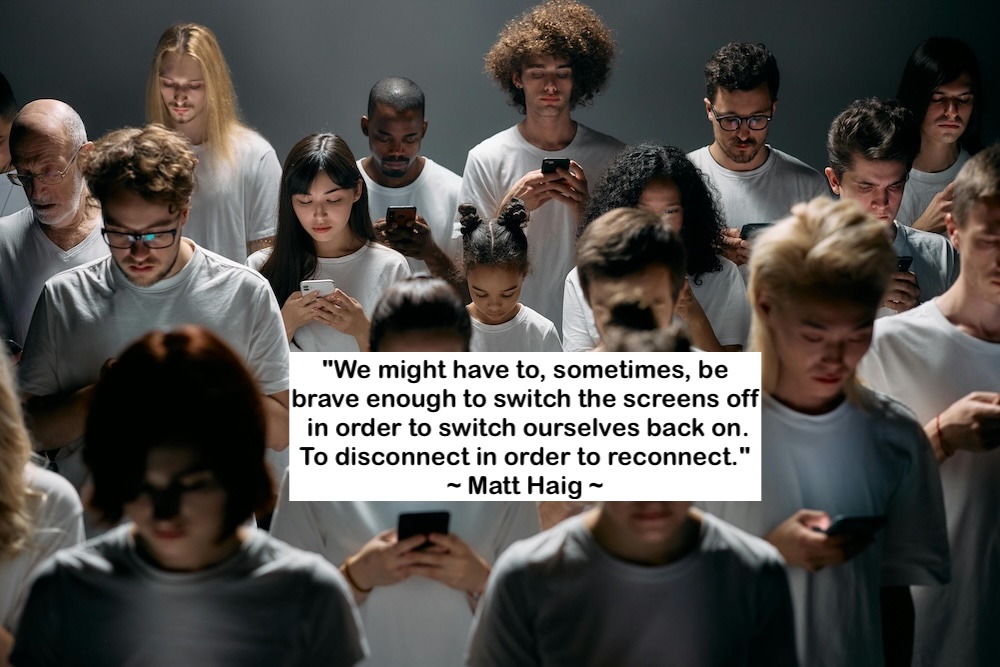
The Saboteur Nobody Promotes, But Everyone Rewards

photo of an iPhone screen with the quote "Your mind is your best friend, but it is also your worst enemy." — Shirzad Chamine

Let me describe someone you might recognize…

They respond to emails within minutes, sometimes seconds. They’re always available. Always on. They volunteer for the extra project, say yes before they’ve thought it through, and feel a low-grade anxiety on the rare occasions they’re not immediately reachable. Their calendar is perpetually full. Their output is impressive. And privately…they are exhausted.

Sound like anyone you might know or even you?

This isn’t a cautionary tale about burnout. This is a description of what peak performance looks like in most organizations. And it’s precisely why one of the most common saboteurs I see in senior professionals is so difficult to name.

Have a guess that this saboteur might be the notorious people Pleaser? Hmmm, not quite. Read on to find out.

Shirzad Chamine, founder of Positive Intelligence, identifies the Hyper-Achiever as one of the most sophisticated self-saboteurs. He uses the word sophisticated because it’s so well disguised. The Hyper-Achiever doesn’t feel like self-sabotage. It feels like drive. Like standards. Like the reason you’ve gotten as far as you have.

And it is, up to a point.

But the Hyper-Achiever is also the voice that tells you your worth is contingent on your output. That stillness is dangerous. That if you’re not producing, responding, achieving, you are falling behind. Becoming irrelevant. Losing ground.

This is why constant work responsiveness is so hard to interrupt. It’s not just a habit. For many high performers, it is an identity.

Here’s the part that tends to land hard with my clients.

  • The Hyper-Achiever doesn’t just affect how much you work. It affects the quality of your thinking. When you are always in reactive mode…always responding, always producing, you never access the slower, deeper thinking that strategic leadership actually requires.

The work you’re doing in distraction mode is real work. But it isn’t your most important work.

Your most important work requires presence. Spaciousness. The ability to sit with a hard question long enough for an original thought to emerge.

And that is exactly what constant responsiveness destroys.

You didn’t develop this pattern because you were weak. You developed it because it worked, and because the people around you rewarded it.

The question now is whether you’re still willing to pay the price. I encourage you to think about the following:

When was the last time you did your most important thinking, and what conditions made that possible?

This week I invite you to notice every time you respond to something immediately, and ask yourself honestly: was that truly urgent, or was that my Hyper-Achiever pushing me?

Try this Mental Reflection prompt: “The story I tell myself about why I need to be constantly available is ________. The cost of that story is ________.”

If you’re ready to stop letting your Hyper-Achiever run the show and start leading from a deeper place, let’s talk. Schedule a conversation with me here.

Your Brain Didn’t Break. The World Did
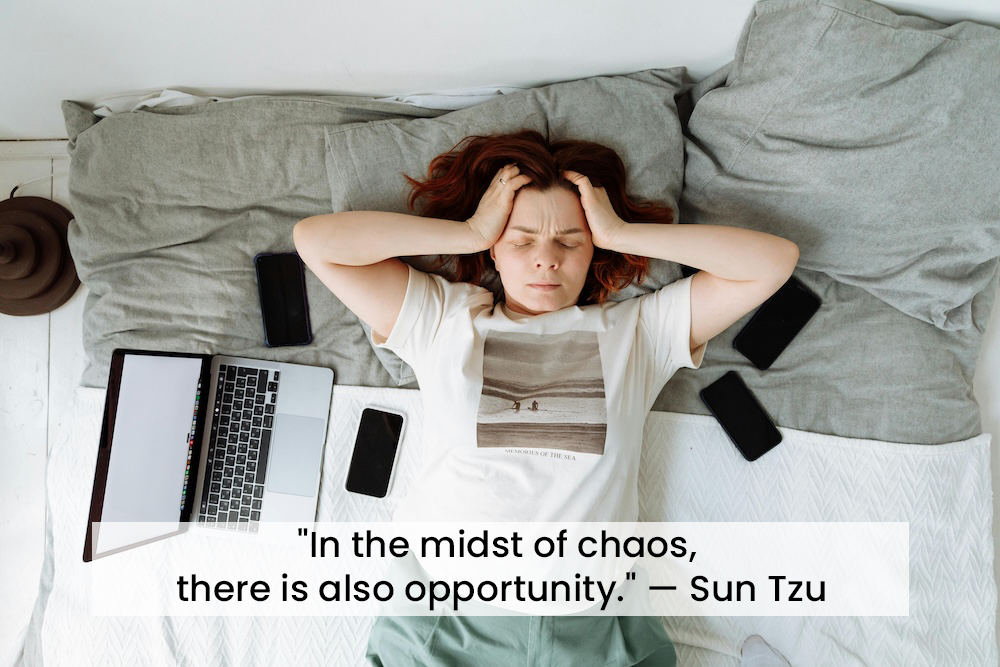
photo of a person on a bed holding their head with the quote "In the midst of chaos, there is also opportunity." — Sun Tzu

You sat down to do one thing today. 

Maybe it was a strategic proposal. A difficult conversation you needed to prepare for. A moment of quiet thinking that your role requires.

And then…your phone buzzed. A news alert. A Slack message. An email marked urgent that probably wasn’t. And just like that, the thing you sat down to do is still sitting there, undone, while you’ve somehow spent 40 minutes reacting to everything else. Sound familiar?

This isn’t a discipline problem. It’s not a time management problem. It’s not even really your problem, in the sense that you did not create it.

Here’s what’s actually happening:

  • Your nervous system was designed for a world that no longer exists. It was built to respond to immediate threats, and it was very good at that. But today’s environment has hijacked that same system.
  • News cycles engineered to provoke. Platforms designed to reward reaction. A workplace culture that equates responsiveness with commitment.
  • Every ping, every scroll, every breaking headline sends a small but real signal to your brain: pay attention to this. This matters. React now. And your brain listens. Every single time.

The result isn’t laziness or lack of focus. The result is a nervous system that is chronically activated, constantly scanning, and deeply conditioned to treat every incoming stimulus as something that requires your immediate attention.

Senior leaders feel this acutely. The higher you go, the more inputs you receive. The more people who need something from you. The more channels demanding your presence.

And here is the part nobody talks about…the distraction isn’t always coming from outside of you. 

Some of it is coming from patterns so deeply embedded in how you work that you’ve never thought to question them. Patterns that once served you. Patterns that got you to where you are.

Patterns that may now be quietly working against you.

The question isn’t whether you’re distracted. You are. We all are. The question is…what inside of you is making it so hard to look away? What is the one distraction you keep returning to — and what do you think it’s actually giving you?

This week, pause before you reach for your phone first thing in the morning. Just notice — what are you hoping to find? What are you trying to avoid? You don’t have to change anything yet. Just observe.

Try this mental reflection prompt: “The distraction I return to most often is ________. What I think it’s actually giving me is ________.”

If what you read today resonated and you’re ready to explore what’s driving your distraction from the inside out, I’d love to have that conversation with you. You can schedule a call with me here.
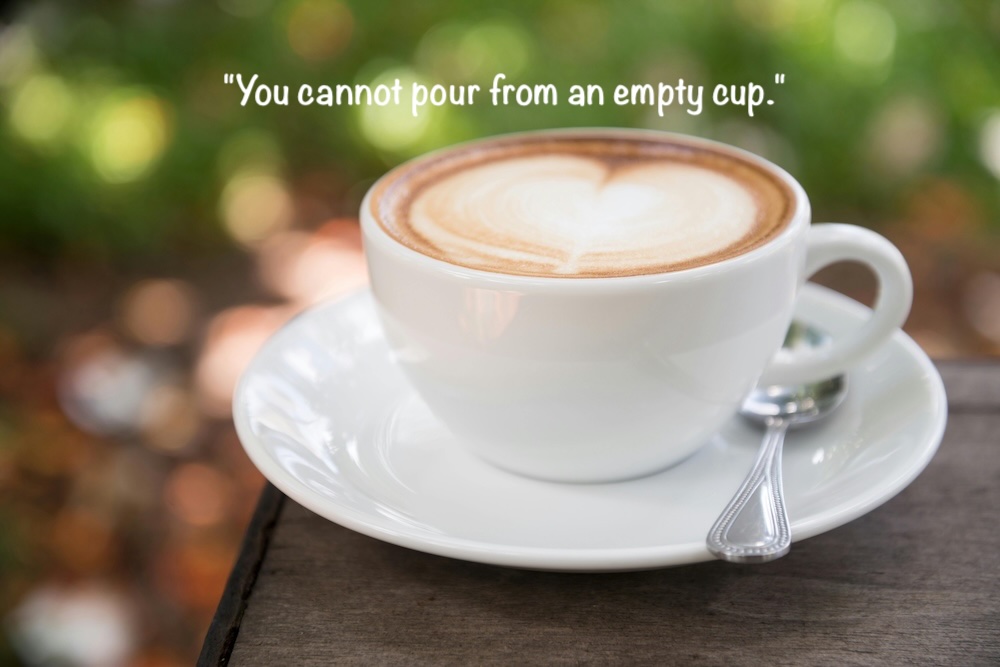

The High Price of Over-Functioning

An image of a cappuccino with a heart shaped out of cream with the quote "You cannot pour from an empty cup."

Are you with me? Have you followed along this month to quiet the noise a bit? Have you taken small actions to set better boundaries? Are you finally able to hear your own voice again?

But can you honor what it’s telling you?

Most leaders I work with are “Over-Functioners.” When a gap appears, you fill it. When a team member is overwhelmed, you absorb their stress.

When a deadline is looming, you bridge the distance with your own nervous system.

On the surface, it looks like dedication. But underneath?

  • You are trading your long-term vision for short-term fires.
  • You are operating at the edge of your capacity 24/7.
  • Your decision-making begins to lack vitality because you are fundamentally losing your overall vitality.

Here is the shift:

Coming home to yourself isn’t just about silence; it’s about stewardship. It’s realizing that your energy is a finite business asset. When you over-function, you aren’t just tired—you’re unavailable for the high-level strategy only you can provide.

This week, I invite you to look at your calendar through the lens of stewardship:

  1. Identify the “Leak”: Where are you doing work that someone else should be doing?
  2. The Energy Audit: Which meeting this week feels like an obligation rather than a contribution?
  3. Protect the Reserve: Leave 15% of your day completely unallocated. Not for emails. Not for “quick pings.” For breathing room.

When you stop over-functioning for everyone else, you finally have the capacity to function fully for yourself.

What does this actually look like in practice?

  • Before you say “yes” to a request today, wait at least 60 seconds, take a deep breath, check-in with yourself to notice how the request feels.
  • Ask your inner voice: Do I have the genuine capacity for this, or am I just filling a gap? Let your inner voice’s answer be enough. No need to further rationalize it.

If you’re ready to move from “exhaustingly available” to “strategically grounded,” I’m here.

Reach out for a 1:1 session to recalibrate your leadership capacity. Click here.

The Voice You’ve Been Trying to Hear

An image of a woman meditating with the quote "Your vision will become clear only when you can look into your own heart. Who looks outside, dreams; who looks inside, awakes." - Carl Jung

What if nothing is wrong with you?

What if the reason you feel unclear…is because you’ve been listening everywhere except the one place that matters most?

YOURSELF.

By now, you’ve probably tried to “figure it out.”

  • More thinking.
  • More strategy.
  • More input.

But clarity isn’t something you force. It’s something you allow. And it begins with tuning back in to yourself.

Your inner voice isn’t dramatic.

It doesn’t push or panic.

It’s steady.
Grounded.
Honest.

But to hear it, you need space.
And you need to trust what comes up.

This is where integration comes in. Not rejecting technology. Not isolating yourself.

But learning to move between both worlds with intention. 

Give yourself a gift and try the following:

  1. When you consciously choose to seek external input do so without losing your internal anchor
  2. Stay informed without becoming overwhelmed
  3. Make decisions that reflect YOUR truth, not just collective noise
  4. Build and begin each day with daily practices that bring you back to yourself.

When you strengthen that connection?

You don’t just lead better.
You live differently.

Here’s a question I’ll leave you with: If you trusted your inner voice fully…
what would you do next?

Sit with that before you answer it quickly.

I’m opening space for Q&A this week. If something in this series resonated, send me your questions or reach out directly.

And if you’re ready for deeper, personalized support, I offer 1:1 coaching designed to help you reconnect to your clarity, energy, and leadership from the inside out. Reach out here.

The Reset You’re Not Scheduling

image of a woman walking on a pedestrian bridge with the quote "In an age of distraction, nothing can feel more luxurious than paying attention. And in an age of constant movement, nothing is more urgent than sitting still." - Pico Iyer

You need a reset.

Not necessarily a vacation.
Nor even a weekend off where you’re still half-plugged into work.

You need a real reset.

Because here’s what happens when you don’t reset:

  • Your thinking capacity becomes limited.
  • Your body holds stress you’re no longer noticing.
  • Your decisions become more reactive than intentional.
  • And eventually… you stop feeling like yourself.

Most professionals try to think their way out of their challenges. But clarity doesn’t always come from thinking more. Sometimes it comes from STEPPING AWAY.

This is where nature becomes more than a nice idea—it becomes a tool. When you step outside without a podcast, without a call, without distraction something shifts.

✅ Your nervous system regulates.
✅ Your perspective widens.
✅ Your energy recalibrates.

And if you go a layer deeper… you begin to notice something else:

✅ There is life and energy in everything.
✅ Not just intellectually—but viscerally.
✅ The air. The movement. The stillness.

It brings you back into connection—not just with your environment, but with yourself.

And from that place? Your inner voice becomes clearer again. Not louder. Just easier to trust.

I invite you to try this reset:

  1. Take 20 minutes this week.
  2. Go outside. No input. No agenda. No earbuds or headphones.
  3. Just observe with your own senses. Breathe. Take notice of each detail.
  4. Let your system reset before you ask it to perform again.

If you’ve been running on empty or feel disconnected from your clarity, this is your invitation to pause.

And if you’re ready to go deeper into this work, I offer 1:1 support to help you reconnect, reset, and lead from a more grounded place. Click here to reach out.