The tension you feel in your body, the claustrophobic worries you have in your mind, can all be alleviated by activating your most portable, powerful tool.
How can you ACTIVATE this tool?
Lean Yin!
In part two of this audio series, I share this 1-minute tip that will:
Teach you what this powerful tool is
Give you specific instruction for how to activate it
Empower you with a portable, free tool you can use anywhere, anytime
Years ago, it was all the rage to Lean In. In hindsight, after her husband tragically died at a too-young age, the author Sheryl Sandberg took a different approach with co-author Adam Grant in their book Option B: Building Resilience. The idea of Leaning Yin is more akin to Option B: to tap into your inner power and find greater meaning and balance in your life. How? By reducing overwhelm and stress, centering and grounding so you can connect to what is most important, and taking small steps to transform your life in a positive way. The results? Fewer regrets, better results, and a positive ripple effect in your company, your family, your community. That benefits us all!
Clients who have taken the six-week mental fitness course with me have learned how to utilize even more tools like this. Learn more here.
You lose out on better opportunities when you are caught up in the intense realities of the daily grind.
So how can you shift gears and get some perspective?
Lean Yin!
In part one of this audio series, I share this 1-minute tip that will:
Focus and ground you
Clarify what’s most important for you
Create some space for you to capture that next opportunity
Enjoy!
What does it mean to Lean Yin?
Years ago, it was all the rage to Lean In. In hindsight, after her husband tragically died at a too-young age, the author Sheryl Sandberg took a different approach with co-author Adam Grant in their book Option B: Building Resilience. The idea of Leaning Yin is more akin to Option B: to tap into your inner power and find greater meaning and balance in your life. How? By reducing overwhelm and stress, centering and grounding so you can connect to what is most important, and taking small steps to transform your life in a positive way. The results? Fewer regrets, better results, and a positive ripple effect in your company, your family, your community. That benefits us all!
As with all births, there were some hiccups along the way, so we are all grateful it arrived safely!
Please take some time to get to meet my new baby and share your feedback!
Second born in early June was…
…the second edition of my first book Refuel Recharge Re-energize, now with a new subtitle Your Guide to Taking Back Control of Your Time and Energy, a new preface, and some rich new additions to the final chapter featuring the Platinum PracticesTM of two fabulous clients.
Assisting with labor and delivery were: Colin (Steve) Peterson for cover re-design and layout, clients Irma Jennings and Domenic Nigro who provided their Personal Performance Platinum PracticesTM, and Kate Kelly again for all her help with related publishing and marketing efforts.
The book still features additional online video and audio content to enrich your experience.
Now available on Amazon.com. Coming soon to iBooks!
To purchase multiple copies in bulk for your next leadership team meeting, an upcoming conference, or even a book club, or to request a signed copy, please contact us directly.
If you’ve read it before, please share your review on Amazon.com!
Third born in early June was…
…the second edition to my foundational course Boost Your Performance In and Out of the Office. This new version still includes a digital workbook, a digital quick guide, and audio recorded chapters, but features a new cover and color scheme to go along with my new logo.
Assisting with labor and delivery was: again, the amazing Kate Kelly my long-time assistant. The talented design team at Quantum Think created my new logo.
Recently, I’ve led client coaching sessions, keynotes, and day-long leadership retreats all featuring content from the Boost Your Performance foundational course and the Refuel book. Please consider these publications as the perfect starting point for your next event!
Thank you to my parents, my husband, and ALL my teachers, guides, clients, friends, colleagues, and vendor partners who provided me with support through the birth of these three babies!
Hummingbirds flap their wings about 80 times per second. Per second! Like you, they expend a lot of energy in their daily lives.
But even so, they still stop to eat.
In May, I spent time with my parents to help out after my mom’s successful hip replacement surgery. Each meal, I sat eating while watching birds at the bird feeders. That’s when I noticed: even hummingbirds stop to eat.
Maybe not all the time if they are hovering above a flower in mid-air, but they do stop when they can place their feet on a branch or a bird feeder.
Today, when you are busily rushing through your day, think of hummingbirds. And stop to eat.
Mindfully doing just one thing, like chewing your food and enjoying your meal, is a wonderful way to bring ease and joy into your day. It’s also an easy way to improve your digestion and strengthen your immune system, since a significant percentage of your immune system comes from the health of your digestive tract where the body fights infection from foreign invaders.
So, again, invite yourself to pause today in your busy flight between activities, take a breath, and stop to eat.
As a student at Grinnell College, I enrolled in a fascinating course taught by Professor Doug Caulkins called MANAGING FOR SUSTAINABILITY AND SOCIAL RESPONSIBILITY. For this class, Grinnell alumna Erin Owen ’94 was invited to campus to speak to us about the topic of sustainability from her point of view.
Among all the alumni who spoke to our class, Erin had the most unique presentation. Usually sustainability is thought of in the context of organizations or institutions, and is focused on keeping the organization working. Erin took a very interesting, but also extremely important approach to sustainability. She raised the question of self-sustainability and are we as individuals behaving in a way that is sustainable to ourselves as humans?
I found this intriguing because in the United States people work like dogs and are concerned with working more than they are with their personal health. This is a huge problem because without healthy and high functioning humans there cannot be high functioning societies or sustainable organizations.
I think this is something that needs to be addressed and it could be a great idea for organizations to adopt and make part of their culture. An organization that emphasizes personal health and personal sustainability will likely have loyal employees and a positive work environment which ultimately leads to sustainability of the organization as a whole.
One of the main problems that Erin stressed was the pace at which people are working. People are expecting more from themselves and their organizations, which is driving the pace of work higher. This is in turn causing people to be constantly working, so that even when they stop working their brain is still working!
This causes what Erin referred to as presenteeism* where people are present physically, but mentally are working on something else. This interested me because I see it every day. People are connected to their devices and social interactions are starting to take place more through technology than face to face interactions. This is a problem for society and organizations.
These issues should be discussed more often with the topic of sustainability because self-sustainability is really the root of sustainability in any context.
Thank you to guest author Nicholas Brule (Grinnell College Class of 2017). Follow Nick on Twitter @NickBrule.
*”Presenteeism” is a term coined by Paul Hemp, the author of a 2004 article titled “Presenteeism: At Work – But Out of It”, published in the Harvard Business Review. In the article, Helm states that presenteeism “costs U.S. companies over $150 billion a year—much more than absenteeism does.” Learn more about hbr.org.



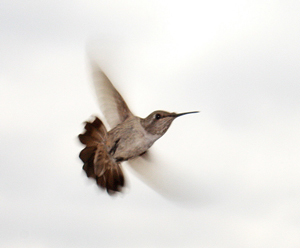 Hummingbirds flap their wings about 80 times per second. Per second! Like you, they expend a lot of energy in their daily lives.
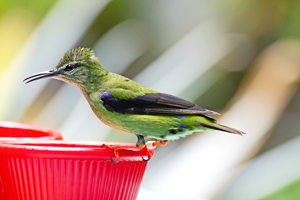 Today, when you are busily rushing through your day, think of hummingbirds. And stop to eat.